人人妻人人爽人人做夜欢视频九色,色综合久久精品亚洲国产,亚洲人成绝网站色www,色翁荡息又大又硬又粗视频,亚洲情综合五月天,老熟女多次高潮露脸视频,18禁成人黄网站免费观看,国产真实老熟女无套内射 Image Modal
                中考網(wǎng)
                全國站
                快捷導(dǎo)航 中考政策指南 2024熱門中考資訊 中考成績查詢 歷年中考分?jǐn)?shù)線 中考志愿填報(bào) 各地中考大事記 中考真題及答案大全 歷年中考作文大全 返回首頁
                您現(xiàn)在的位置:中考 > 初中英語 > 英語語法 > 正文

                2020年中考英語語法專題詳解四

                來源:網(wǎng)絡(luò)資源 作者:中考網(wǎng)整理 2019-08-11 09:02:56

                中考真題

                免費(fèi)領(lǐng)資料
                  專題四 代詞
                 
                  一、 代詞概述
                 
                  代詞是代替名詞的一種詞類。大多數(shù)代詞具有名詞和形容詞的功能。
                 
                  二、代詞分類
                 
                  英語中的代詞,按其意義、特征及在句中的作用主要分為:人稱代詞、物主
                 
                  代詞、反身代詞、指示代詞、不定代詞、疑問代詞。
                 
                  1、 人稱代詞及其用法
                 
                  1)人稱代詞主格和賓格
                 

                人稱

                單、復(fù)數(shù)

                主格

                賓格

                第一人稱

                單數(shù)

                I

                me

                復(fù)數(shù)

                we

                us

                第二人稱

                單數(shù)

                you

                you

                復(fù)數(shù)

                you

                you


                第三人稱


                單數(shù)


                he

                him

                she

                her

                it

                it

                復(fù)數(shù)

                they

                them

                 
                  2) 人稱代詞的用法
                 
                  ① 人稱代詞主格在句子中擔(dān)任主語。
                 
                  例如:She likes watching movies.她喜歡看電影。
                 
                  They have been to America twice..他們到過美國兩次。
                 
                  ② 人稱代詞賓格在句子中擔(dān)任動詞賓語、介詞賓語或表語。
                 
                  例如: We listen to them and they help us.我們聽他們,他們幫我們。
                 
                  ---Who is knocking at the door? --It’s me.—誰在敲門?—是我。
                 
                  2、 物主代詞及其用法
                 
                  1)形容詞性和名詞性物主代詞
                 

                人稱

                單、復(fù)數(shù)

                形容詞性

                名詞性

                詞義

                第一人稱

                單數(shù)

                my

                mine

                我的

                復(fù)數(shù)

                our

                ours

                我們的

                第二人稱

                單數(shù)

                your

                yours

                你的

                復(fù)數(shù)

                your

                yours

                你們的


                第三人稱


                單數(shù)

                his

                his

                他的

                her

                hers

                她的

                its

                its

                它的

                復(fù)數(shù)

                their

                theirs

                他們的

                 
                  2)物主代詞的用法
                 
                  ① 形容詞性物主代詞相當(dāng)于形容詞,在句子中擔(dān)任定語修飾名詞,一般不單獨(dú)使用。
                 
                  例如:This is my book. Your book is over there.這是我的書。你的書在那里。
                 
                  They are our new friends.他們是我們的新朋友。
                 
                  ②名詞性物主代詞語法上相當(dāng)于名詞,意義上相當(dāng)于“形容詞性物主代詞+名詞”,經(jīng)常用其來避免和前面提到的名詞重復(fù)。
                 
                  例如:This is my dictionary. Where is yours (=your dictionary)?這是我的詞典。你的(詞典)在哪里?
                 
                  My idea is just the same as his(=his idea).我的想法正如他的(想法)。
                 
                  3、反身代詞及其用法
                 
                  1)反身代詞的構(gòu)成
                 

                人稱

                單、復(fù)數(shù)

                詞形

                詞義

                第一人稱

                單數(shù)

                myself

                我自己

                復(fù)數(shù)

                ourselves

                我們自己

                第二人稱

                單數(shù)

                yourself

                你自己

                復(fù)數(shù)

                yourselves

                你們自己


                第三人稱


                單數(shù)

                himself

                他自己

                herself

                她自己

                itself

                它自己

                復(fù)數(shù)

                themselves

                他們自己

                 
                  2)反身代詞的用法
                 
                  ① 反身代詞在句子中擔(dān)任動詞賓語或介詞賓語。
                 
                  例如:The boy is too young to look after himself.這男孩太小了無法照顧自己。
                 
                  They did the job all by themselves.這件工作他們完全是自己做的。
                 
                  ② 反身代詞常用詞組
                 
                  例如:teach oneself自學(xué) learn by oneself自學(xué) enjoy oneself玩得愉快
                 
                  hurt oneself傷了自己 help oneself to自便 come to oneself蘇醒
                 
                  by oneself單獨(dú);親自
                 
                  4、 指示代詞及其用法
                 
                  1) 指示代詞:單數(shù)this(這)、 that(那);復(fù)數(shù)these(這些), those(那些)
                 
                  2) 指示代詞的用法
                 
                  ① this/these用于指代近距離的人或事物。
                 
                  例如:This is my friend and these are his new books.這是我的朋友。這些是
                 
                  他的新書。
                 
                  ② that/those用于指代遠(yuǎn)距離的人或事物。
                 
                  例如:Look!That girl in red is Kate.瞧!那個(gè)穿紅衣服的女孩是凱特。
                 
                  ③ 打電話時(shí)用this介紹自己,用that詢問對方。
                 
                  例如:This is Mar speaking. Is that Mrs Jones?我是瑪麗,您是瓊斯夫人嗎?
                 
                  5、 不定代詞及其用法
                 
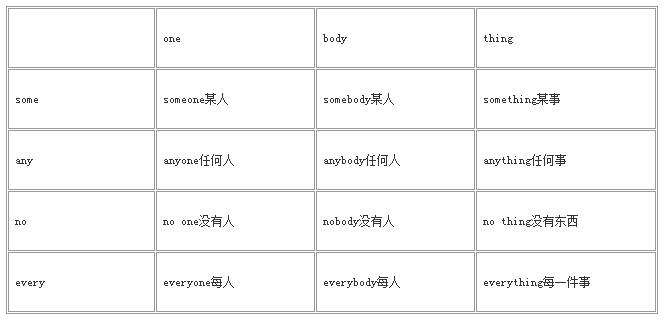
                  不定代詞是比較復(fù)雜的一類代詞,在詞形上有簡單的不定代詞和復(fù)合不定代詞兩種形式,分別列表如下。
                 
                  1) 表一:初中階段常見的簡單的不定代詞
                 

                不定代詞

                常用詞義

                some,any

                一些(人或物);任何(人或物)

                many,much

                許多(人或物)

                few,little

                幾乎沒有(人或物)

                a few,a little

                有少數(shù)或少量(人或物)

                both

                兩者都

                all

                三者及以上都

                either

                兩者之一;或者……或者

                neither

                兩者都不

                none

                三者及以上都不

                another

                三者以上中的任意一個(gè)

                one

                一個(gè)

                other,others

                其他的(泛指)

                the other,the others

                其他的(特指)

                 
                  表二:復(fù)合不定代詞
                 
                 
                  2) 不定代詞的用法
                 
                  在實(shí)際使用中,普通不定代詞多數(shù)時(shí)候用作形容詞修飾名詞。
                 
                  ① some和any。兩者均可修飾可數(shù)和不可數(shù)名詞。一般情況下,some用于肯定句,any用于否定句、疑問句和條件句中。但在說話人想要得到肯定回答或表達(dá)請求、建議的疑問句中用some。
                 
                  例如:There are some students in the classroom, but there aren’t any teachers.
                 
                  教室里有一些學(xué)生,但沒有老師。
                 
                  ---Would you like to have some tea or coffee? ---Neither, thanks.
                 
                  --想要喝茶還是咖啡?--謝謝,兩個(gè)都不要。
                 
                  ② many 和much。many修飾可數(shù)名詞的復(fù)數(shù)形式,much修飾不可數(shù)名詞。
                 
                  兩者均可以和表示程度的副詞so,too,as,how連用構(gòu)成too many/much, so many/much, as many/much as, how many/much.
                 
                  例如:I have too much work to do.我有太多的工作要做。
                 
                  How did you make so many mistakes?你怎么會犯這么多錯(cuò)誤?
                 
                  Please speak English as much as possible.請盡量說英語。
                 
                  ③ few, a few 和little, a little. few和a few修飾可數(shù)名詞,little和a little修飾不可數(shù)名詞。few,little表示否定,a few,a little表示肯定。
                 
                  例如:He is a new student in the school, so he has few friends.他是本校的新生,所以幾乎沒有朋友(表示否定)。
                 
                  I have so little money that I can’t afford the new magazine. Can you lend me some?我?guī)缀鯖]錢了,買不起這本雜志(表示否定)。你能借我一些嗎?
                 
                  ---Can I have a few words with you, Mrs Brown? –Sure, I have a little time. –布朗夫人,我可以和你說幾句話嗎(表示肯定)?--當(dāng)然可以,我有一點(diǎn)點(diǎn)時(shí)間(表示肯定)。
                 
                  ④ both和all。both只能用于指代兩者,all指代三者或以上的人或物。
                 
                  例如:My parents are both teachers. Both my brother and I are students. We all live in Changsha.我父母親都是老師。我哥和我是學(xué)生。我們都生活在長沙。
                 
                  ⑤ either, neither和none。either只能是“兩者中取其一”,neither是“兩者都不”,是both的反義詞,none“都不”是all的反義詞。
                 
                  例如:Either you or your sister has to help your dad in the garden.你或者你姐姐得幫助你爸爸在花園里干活。(只要一個(gè)人幫助爸爸干活即可)
                 
                  ---Would you like some milk or coffee? –Neither. Just water, please.—你想要牛奶還是咖啡?--都不要,水就可以。
                 
                  They are all teenagers. None of them should be allowed to smoke.他們都是青少年,誰都不應(yīng)該獲許抽煙。
                 
                  ⑥ other, others, the other, the others.概括地說,不帶the的為泛指,帶the的為特指,帶s的指代復(fù)數(shù)的人或物,不帶s的指代單數(shù)的人或物。
                 
                  例如:Beijing is larger than the other cities in China.北京比中國其他城市大。
                 
                  Lei Feng was always ready to help others(=other people)。雷鋒樂于助人。
                 
                  I have only two good friends. One is Jack, the other is David.我只有兩個(gè)好朋友,一個(gè)是杰克,另一個(gè)是大衛(wèi)。
                 
                  I bought six new books yesterday. One is English, the others(=the other books) are Chinese.我昨天買了六本書。一本是英語,其余的(書)都是中文。
                 
                  ⑦ one, another, one指代上文提到過的單數(shù)可數(shù)名詞,避免重復(fù)。another指的是三者以
                 
                  上中的任意一者,還可以表達(dá)“額外添加”的意思。
                 
                  例如:This building is taller than that one.這個(gè)建筑比那棟高。
                 
                  I have already spent half an hour on the job, but I need another ten minutes to finish it.
                 
                  我已經(jīng)花了半個(gè)小時(shí)做這件工作,但是我還要十分鐘才能夠完成。
                 
                  ⑧ 復(fù)合不定代詞的句法功能可以參考some、any、no、every的用法。但下列幾點(diǎn)必須
                 
                  注意:
                 
                  a)復(fù)合不定代詞在句子中擔(dān)任主語時(shí),謂語動詞要用單數(shù)形式。
                 
                  例如:Is there anything wrong with the computer?電腦出問題了嗎?
                 
                  Everybody is here. Let’s begin the meeting.大家到齊了,我們開會吧。
                 
                  b)修飾復(fù)合不定代詞的形容詞要放在他們的后面,做后置定語。
                 
                  例如:Be quiet, please. I have something important to tell you.請安靜,我有重要
                 
                  的事情要告訴你們。
                 
                  6、 疑問代詞及其用法
                 

                疑問代詞

                主要用法

                例句

                who

                “誰”,主格形式作主語

                Who can answer the question?

                Who is the man over there?

                whom

                “誰”,賓格形式,口語中往往

                被who代替

                Whom/whom are you talking to?

                whose

                “誰的”所有格形式

                Whose exercise book is this?

                Whose is this exercise book?


                what

                詢問不定書目中的“哪個(gè)”、

                “哪些”,沒有范圍的限定;也

                可用于詢問某人的職業(yè)

                What are you going to do?

                What class are you in?

                What is your mother?

                which

                “哪個(gè)”、“哪些”,詢問一定

                范圍內(nèi)特指的人或物

                Which class are you in, Class 1 or

                Class 2?

                 
                  疑問代詞在句中起名詞詞組的作用,用來構(gòu)成疑問句。
                 
                  實(shí)戰(zhàn)演練(2×50) 計(jì)分:
                 
                  1 ---Is that man in blue your father? ---No, _______ is my headmaster.
                 
                  A. he B. him C. she
                 
                  2. ---Laura, this is my backpack. Where is _______? ---Mine is over there.
                 
                  A. your B. yours C. his
                 
                  3. ---Is the woman who walked past just now your teacher? ---Yes, she teaches _____ Chinese.
                 
                  A. us B. our C. ours
                 
                  4. ---Is David _________ cousin or theirs? ---He is my cousin.
                 
                  A. your B. yours C. you
                 
                  5. Excuse me, _____pen is broken. May I use ________?
                 
                  A. my, your B. I, yours C. my, yours
                 
                  6. ---Is this your MP4, Mike? ---No, it’s ______.
                 
                  A. his B. her C. my
                 
                  7. We must learn English by __________.
                 
                  A. us B. our C. ourselves
                 
                  8. Could you lend me ______ bike? I lost ______ last Saturday.
                 
                  A. your, my B. your, mine C. yours, mine
                 
                  9. ---Who taught _____ German? ---Nobody. She learned all by _______.
                 
                  A. she, her B. her, herself C. hers, herself
                 
                  10. --- Which would you like, bread or rice? --- ______ of them. I’m full now.
                 
                  A. Either B. Neither C. All
                 
                  11. ---_______does your cousin look like? ---He’s tall and thin.
                 
                  A. What B. Who C. Which
                 
                  12. Believe yourself. You’re better than ________. You’re the best. Wish you success.
                 
                  A. anyone else B. some else C. else anyone
                 
                  13. Most young people find _______ exciting to watch a football match.
                 
                  A. it B. this C. that
                 
                  14. ---_______ are you talking about? ----The Olympic Games in Beijing.
                 
                  A. What B. How C. Whom
                 
                  15. ---What about this T—shirt? ---I don’t like the color. Please show me _____one.
                 
                  A. other B. the other C. another
                 
                  16. ---Did you enjoy ____ at the party, Jimmy? –Yes, Mum. I enjoyed ___very much.
                 
                  A. yours, ourselves B. yourselves, myself C. yourself, myself
                 
                  17. They three were all very tired, but ______ of them would stop to have a rest.
                 
                  A. some B. none C. all
                 
                  18. There is ______ knocking at the door. Go and see who it is.
                 
                  A. someone B. anybody C. nobody
                 
                  19. Do you know the girl between Lucy and ______?
                 
                  A. she B. his C. me
                 
                  20. ---Could you tell me ______ to do next? ---Nothing more. Let’s have a rest.
                 
                  A. what B. how C. when
                 
                  21. ---Can we put our sports shoes here? ---Oh, yes. Put ______ here, please.
                 
                  A. them B. their C. they
                 
                  22. ---______did Mr Wang leave in a hurry? ---Perhaps to meet a friend. Who knows?
                 
                  A. Where B. For what C. With whom
                 
                  23. _____ isn’t easy to learn a foreign language well. But don’t give it up.
                 
                  A. That B. It C. This
                 
                  24. ---Hello! ---_______is Mary speaking. Is ______ Lily? --- Yes, speaking.
                 
                  A. This, this B. This, that C. That, this
                 
                  25. ---Who told you Sam and Kitty got married? --- A friend of _______.
                 
                  A. you B. her C. mine
                 
                  26.There are many tall buildings on _______ sides of the street.
                 
                  A. either B. all C. both
                 
                  27 I asked both Mary and Lucy to my birthday party, but ________ of them can come.
                 
                  A. both B. neither C. all
                 
                  28.---Mum, Li Ming bought a parrot yesterday. Could you please buy ____ for me?
                 
                  ---Sure. But you must take good care of it.
                 
                  A. one B. it C. that
                 
                  29.The weather in Hengyang is different from ______ in Beijing.
                 
                  A. one B. it C. that
                 
                  30.As we all have grown up, we should learn to look after ________.
                 
                  A. ourselves B. us C. myself
                 
                  31.Never say you’re a fool. Everyone is good at ________.
                 
                  A. something B. anything C. everything
                 
                  32 I like pop music, but _______ my father _______ my mother likes it.
                 
                  A. both; and B. either; or C. neither; nor
                 
                  33.---When shall we go to the museum, this afternoon or tomorrow morning?
                 
                  ---_______ is OK. I’m free these days.
                 
                  A. Both B. All C. Either
                 
                  34 There are only _________ new words in the passage, but I know _____ of them.
                 
                  A. some; all B. a few; none C. lots of; a few
                 
                  35 ---Who is singing in the next room? --- _______ must be Marie.
                 
                  A. It B. She C. This
                 
                  36.The machines made in China are cheaper than ________ made in Japan.
                 
                  A. ones B. that C. those
                 
                  37 ---Two Evening Papers, please! ---Only one copy left. Would you like to have ___, sir?
                 
                  A. one B. it C. this
                 
                  38 ---Do you like talking with your friends on the phone or on mobile phone?
                 
                  ---_________. I enjoy using QQ.
                 
                  A. Either B. Neither C. None
                 
                  39 The pears in my basket are smaller than _______ in Jim’s.
                 
                  A. those B. that C. ones
                 
                  40.We can’t leave our grandparents by _________.
                 
                  A. they B. them C. themselves
                 
                  41.---Can I talk to you for a minute, Brian? ---Sure. I have ______ time.
                 
                  A. a few B. little C. a little
                 
                  42.---Is _______ here today? ---No. Han Mei isn’t here. Maybe she’s ill.
                 
                  A. someone B. anyone C. everyone
                 
                  43.---Have you finished your task? ---No, I’ll finish it in _______ ten minutes.
                 
                  A. less B. other C. another
                 
                  44.Mrs White has two children. _______ is a driver, and ______ is a nurse.
                 
                  A. One; another B. One; the other C. One; other
                 
                  45.The old woman asked _______, “What should I do?”
                 
                  A. herself B. her C. hers
                 
                  46.Either you or I _______ right.
                 
                  A. is B. am C. are D. be
                 
                  47 We found _______ necessary to protect the environment.
                 
                  A. it B. this C. that
                 
                  48.It was ________ fine day that they went to the park.
                 
                  A. so a B. a so C. such a
                 
                  49._________went surfing at the beach because of the terrible weather.
                 
                  A. Someone B. No one C. Nothing
                 
                  50.---______ did Mr Wang leave in a hurry? ---Perhaps to meet a friend. Who knows?
                 
                  A. How B. Where C. For what
                 
                  1-5 ABAAC 6-10 ACBBB 11-15 AAAAC 16-20 CBACB 21-25 ABBBC
                 
                  26-30 CBACA 31-35 ACCBA 36-40 CBBAC 41-45 CCCBA 46-50 BACBC
                 
                新初三快掃碼關(guān)注
                 
                中考網(wǎng)微信公眾號
                 
                每日推送學(xué)習(xí)技巧,學(xué)科知識點(diǎn)
                 
                助你迎接2020年中考!


                one

                body

                thing

                some

                someone某人

                somebody某人

                something某事

                any

                anyone任何人

                anybody任何人

                anything任何事

                no

                no one沒有人

                nobody沒有人

                no thing沒有東西

                every

                everyone每人

                everybody每人

                everything每一件事

                one

                body

                thing

                some

                someone某人

                somebody某人

                something某事

                any

                anyone任何人

                anybody任何人

                anything任何事

                no

                no one沒有人

                nobody沒有人

                no thing沒有東西

                every

                everyone每人

                everybody每人

                everything每一件事

                one

                body

                thing

                some

                someone某人

                somebody某人

                something某事

                any

                anyone任何人

                anybody任何人

                anything任何事

                no

                no one沒有人

                nobody沒有人

                no thing沒有東西

                every

                everyone每人

                everybody每人

                everything每一件事

                one

                body

                thing

                some

                someone某人

                somebody某人

                something某事

                any

                anyone任何人

                anybody任何人

                anything任何事

                no

                no one沒有人

                nobody沒有人

                no thing沒有東西

                every

                everyone每人

                everybody每人

                everything每一件事


                one

                body

                thing

                some

                someone某人

                somebody某人

                something某事

                any

                anyone任何人

                anybody任何人

                anything任何事

                no

                no one沒有人

                nobody沒有人

                no thing沒有東西

                every

                everyone每人

                everybody每人

                everything每一件事

                   歡迎使用手機(jī)、平板等移動設(shè)備訪問中考網(wǎng),2025中考一路陪伴同行!>>點(diǎn)擊查看

                • 歡迎掃描二維碼
                  關(guān)注中考網(wǎng)微信
                  ID:zhongkao_com

                • 歡迎掃描二維碼
                  關(guān)注高考網(wǎng)微信
                  ID:www_gaokao_com

                • 歡迎微信掃碼
                  關(guān)注初三學(xué)習(xí)社
                  中考網(wǎng)官方服務(wù)號

                熱點(diǎn)專題

                • 2024年全國各省市中考作文題目匯總
                • 2024中考真題答案專題
                • 2024中考查分時(shí)間專題

                [2024中考]2024中考分?jǐn)?shù)線專題

                [2024中考]2024中考逐夢前行 未來可期!

                中考報(bào)考

                中考報(bào)名時(shí)間

                中考查分時(shí)間

                中考志愿填報(bào)

                各省分?jǐn)?shù)線

                中考體育考試

                中考中招考試

                中考備考

                中考答題技巧

                中考考前心理

                中考考前飲食

                中考家長必讀

                中考提分策略

                重點(diǎn)高中

                北京重點(diǎn)中學(xué)

                上海重點(diǎn)中學(xué)

                廣州重點(diǎn)中學(xué)

                深圳重點(diǎn)中學(xué)

                天津重點(diǎn)中學(xué)

                成都重點(diǎn)中學(xué)

                試題資料

                中考壓軸題

                中考模擬題

                各科練習(xí)題

                單元測試題

                初中期中試題

                初中期末試題

                中考大事記

                北京中考大事記

                天津中考大事記

                重慶中考大事記

                西安中考大事記

                沈陽中考大事記

                濟(jì)南中考大事記

                知識點(diǎn)

                初中數(shù)學(xué)知識點(diǎn)

                初中物理知識點(diǎn)

                初中化學(xué)知識點(diǎn)

                初中英語知識點(diǎn)

                初中語文知識點(diǎn)

                中考滿分作文

                初中資源

                初中語文

                初中數(shù)學(xué)

                初中英語

                初中物理

                初中化學(xué)

                中學(xué)百科

                主站蜘蛛池模板: 国产性生大片免费观看性| 日本嫩交12一16xxx视频| 国产成人精选在线观看不卡| 最新精品国偷自产在线| 日本高清在线中字视频| av天堂精品久久久久| 一边摸一边抽搐一进一出视频| 无套熟女av呻吟在线观看| 国产三级a三级三级| 欧美牲交a欧美牲交aⅴ免费真| 国产日韩在线亚洲色视频| 成人综合人人爽一区二区| 免费国产黄网站在线观看视频| 色欲aⅴ亚洲情无码av| 亚洲成人av高清在线| 四虎成人精品无码永久在线| 久9视频这里只有精品8| 国产+免费+无码| 国产麻豆剧果冻传媒白晶晶| 无码免费毛片手机在线无卡顿| 18禁无遮挡啪啪无码网站| 曰韩少妇内射免费播放| 国产偷国产偷亚洲清高孕妇| 亚洲欧洲精品成人久久曰| 少妇被躁爽到高潮无码久久| 日本韩国亚洲欧美在线| 久久精品国产亚洲av麻豆软件| 法国伦理少妇愉情| 成人亚洲一区二区三区在线| 亚洲乱理伦片在线观看中字| 三个男吃我奶头一边一个视频| 好男人社区神马在线观看www| 狠狠色噜噜狠狠狠狠2021| 国产香蕉尹人在线视频你懂的| 国产suv精品一区| 免费欧三a大片| 久久美女夜夜骚骚免费视频| 日韩精品av一区二区三区| 亚洲色欲色欱www在线| 影音先锋2020色资源网| 大JI巴好深好爽又大又粗视频|